![[PHOTOS] Boys Basketball Sectionals](https://theseymourowl.com/wp-content/uploads/2026/03/14-IMG_9111-1200x800.jpg)
![[PHOTOS] Boys 25-26 Basketball Season](https://theseymourowl.com/wp-content/uploads/2026/03/2-_DSC0900-1-1200x809.jpg)
![[PHOTOS] Student vs. Staff](https://theseymourowl.com/wp-content/uploads/2026/03/152-_DSC0117-1200x800.jpg)









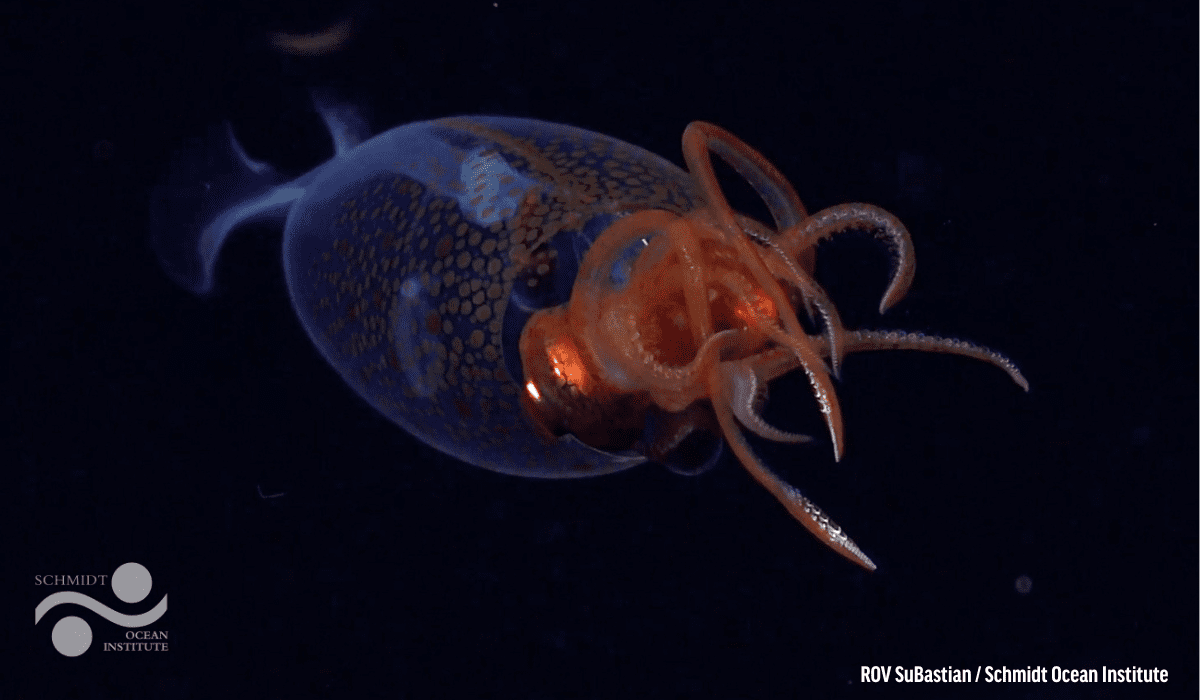
Also referred to as the ‘glass squid,’ colossal squids (Mesonychoteuthis Hamiltoni) are a species that many know about, but have never seen. However, the first sighting of a baby colossal squid in its natural habitat occurred last year, on March 9, 2026. The colossal squid was discovered in the South Atlantic Ocean by a research vessel that was using a remotely-operated deep sea vehicle.
Around 600m (~2,000 feet) deep around the South Sandwich Islands, the encounter showed the squid being around 30cm long, with red, glowing, and iridescent reflective eyes. The squid has small hooks and suckers around its eight arms, having hooks in the middle portion of each arm. This is where its name comes from, “meso” meaning mid, “onycho” meaning hook, and “teuthis” meaning squid. Interestingly, the squid’s red coloration of arms and rust red chromataphors (pigmented cells) on the mantle suggest that the squid has the ability to switch between transparent and opaque.
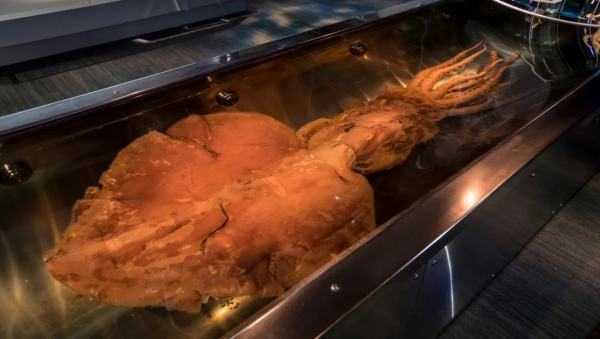
Colossal squids can get up to 23 feet long and weigh over 1,000 pounds, which makes them the heaviest invertebrates on the planet. There have been other sightings of these squids; however, these squids were either discovered by their catch or dead, floating on the surface. For example, a colossal squid has been caught and preserved in New Zealand (as shown in the image). Colossal squids primarily reside around the polar regions, indicating that squid species evolve separately from other species–such as the giant squid, which inhabit the middle regions of the Earth’s seas. Colossal squids were first discovered in 1925, with tentacle and head remains being found inside a sperm whale’s stomach. However, some legends suggest earlier, unreported sightings of these creatures; for example, in The Odyssey, a giant sea creature with various tentacles named Scylla is described. With hundreds of squid species in the ocean ranging from the size of a thumbnail to over 7 times the size of a human, it’s quite likely that a larger species of squid resides deeper within the ocean.
Sources:
The life and habits of a colossal squid. (2016, December 29). Museum of New Zealand Te Papa Tongarewa, Wellington, NZ. https://www.tepapa.govt.nz/discover-collections/read-watch-play/colossal-squid/life-and-habits-colossal-squid
Wikipedia Contributors. “List of Colossal Squid Specimens and Sightings.” Wikipedia, Wikimedia Foundation, 15 Sept. 2025.
Mock-Bunting, Logan. “First Confirmed Footage of a Colossal Squid—and It’s a Baby! – Schmidt Ocean Institute.” Schmidt Ocean Institute, 15 Apr. 2025, schmidtocean.org/first-colossal-squid-footage/.
TED-Ed. “Why Did It Take so Long to Find Giant Squids? – Anna Rothschild.” YouTube, 26 Sept. 2024, www.youtube.com/watch?v=T1aZxcyiYAw.